Hospital & Clinic Furniture
Hospital and clinic furniture covers every piece a healthcare facility needs to receive and treat patients, from the examination couch in the consultation room to the seating in the waiting area. At Quirumed we group the full range in one international catalogue, organised by subcategory. The selection runs from examination couches and treatment chairs through medical stools, instrument trolleys, examination lamps, ward screens and waiting room furniture. The catalogue serves general practices, private clinics, outpatient departments, long-term care facilities, day-surgery centres and hospital wards renewing their fit-out. Orders ship internationally from our European distribution hub, with commercial support for facility managers, practice owners and project teams equipping a new room or replacing pieces after years of service. Browse the subcategories below, or jump straight to the buying guide if you are fitting out a room from scratch.
What is hospital and clinic furniture?
Hospital and clinic furniture is the set of pieces designed specifically for healthcare environments, with surfaces that wipe down between patients, frames built for heavier daily loads and geometry adapted to clinical workflows. In a typical clinic or hospital ward eight categories appear again and again:
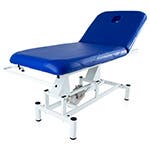
- Examination couches and treatment beds — electric, hydraulic or fixed height.
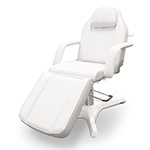
- Treatment chairs — reclining, multifunction, hydraulic or electric.
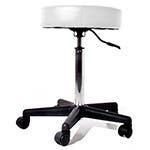
- Medical stools — with or without backrest, five wheels for stability.
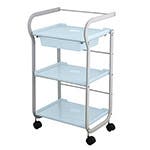
- Instrument trolleys and auxiliary tables — with drawers, in stainless steel or with a UV lamp.
- Waiting room furniture — chairs, sofas, reception desks.
- Examination lamps and magnifying lamps — for dermatology, minor procedures or wound assessment.
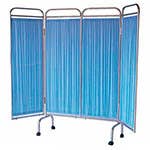
- Ward screens and dividers — for patient privacy in shared rooms.
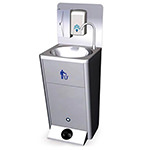
- Hygiene units — paper dispensers, soap dispensers, hand dryers.
The sections that follow describe each category with the formats most often requested by international buyers, plus the models that match each buyer profile.
Examination couches and treatment beds
The examination couch is the central piece in any consultation room. Three formats cover most of the demand we see across international clinics. Electric couches with motorised height adjustment suit practices with back-to-back appointments, where quick repositioning matters at the end of a long day. Hydraulic couches fit settings with a steady pace, such as physiotherapy, manual therapy and chiropractic rooms. Fixed-height couches remain the base option for examination rooms with a predictable workflow.
Width and number of sections complete the choice. A couch of 60 to 66 cm covers standard examinations and chiropractic work. A 70 cm couch fits general treatments and sports medicine. The Bobath couch, around 107 cm wide, is the right option for neurological rehabilitation and patients who need extra room. Two or three sections allow the head or legs to be raised for specific positions.
See the full range in the subcategory examination couches and treatment beds.
Treatment chairs for consultation rooms and clinics
Treatment chairs cover a wide range of specialties: dermatology, blood draw, IV therapy, podiatry, gynaecology and minor surgery. The drive types split the catalogue into three groups. Hydraulic chairs offer manual height adjustment and straightforward maintenance. Electric chairs with one or more motors allow quick repositioning between patients. Fixed-height chairs serve as the base option for routine procedures.
For practices that want a single piece to handle multiple procedures, multifunction chairs with three motors give independent positioning of the backrest, seat and leg rest. Clinicians working in mixed-use practices often mention the ease of repositioning between patients as the main gain when moving from a fixed chair to a motorised model. See the complete selection in the subcategory medical chairs.
Medical stools for clinical staff
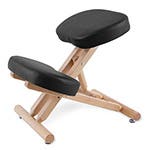
Stools support the posture of clinical staff throughout the whole working day. A suitable stool combines three features: smooth height adjustment through a gas spring or hydraulic system, five wheels for stability and a base that wipes down easily between patients. The range includes three main types. Stools with a backrest suit clinicians who spend long periods seated. Stools without a backrest fit tighter workstations and procedures that require full freedom of movement. Saddle stools bring the clinician close to the patient for short, precise tasks.
Instrument trolleys and auxiliary tables
Trolleys keep instruments, dressings, sterile sets and consumables within reach during treatment. The catalogue covers several formats:
- Auxiliary trolleys with two or three drawers — light, mobile, suited to consultation rooms with limited space.
- Multifunction trolleys with an integrated UV lamp — useful for podiatry, skin care and practices that clean instruments between procedures.
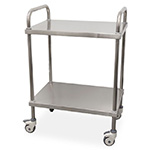
- Stainless steel work tables and auxiliary tables on wheels — stable surfaces for dressing preparation, wound care or laying out instrument sets.
- Linen trolleys and transport carts — for the logistical flows between treatment rooms and the inpatient area.
Trolleys with an integrated UV lamp are frequently requested by podiatry practices and by skin treatment centres. The full selection is in the subcategory medical trolleys.
Waiting room and reception furniture
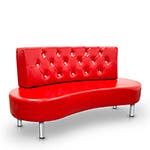
The waiting area sets the first impression a patient takes away from the clinic, and at the same time it is the workspace of the reception team. A typical clinic reception combines four elements. There is a reception desk with integrated storage and an ergonomic office chair with a gas spring adjustment for the reception staff. To this you add several seats for patients and a small side table for information leaflets. Single chairs suit clinics with a clinical look; two- or three-seater sofas fit better in larger clinics with a high volume of appointments per day.
Upholstery in this zone needs to withstand wiping with common disinfectants. Synthetic leather and technical vinyl covers keep their look over time, even with intensive use.
Examination lamps, ward screens and hygiene units
Alongside the main furniture, several complementary categories complete the fit-out of a treatment room. Examination lamps and magnifying lamps deliver the precision light needed for dermatology, minor procedures, ear assessment or wound review. Lamps on a mobile base with wheels are useful when a single lamp serves several rooms.
Ward screens divide the space when patient privacy is required during examination or changing. Three-panel models on wheels remain the most versatile option for shared consultation rooms. Hygiene units — paper dispensers, soap dispensers, hand dryers and waste bins — close the zone, with finishes that withstand frequent cleaning with disinfectant products.
How to choose hospital and clinic furniture for your facility
In practice the choice comes down to four straightforward criteria: the specialty of the practice and the procedures performed, the number of patients per day, the floor area available and the budget cycle. A general practitioner opening a new room needs a stable examination couch, a backrest stool, an auxiliary trolley, a reception desk and a few waiting room seats. A multi-specialty clinic adds several couches across rooms, electric reclining treatment chairs, a ward screen, an examination lamp and a larger waiting area.
Three practical rules that help with the decision:
- Plan for daily workload, not for the busiest day of the week. Motorised couches and electric chairs become a sound investment from four patients per day upwards, where quick repositioning makes a difference by the end of the day.
- Map the power supply and the movement routes before delivery. Electric couches, examination lamps and motorised chairs each need their own socket. Pieces on wheels need clear pathways between treatment area and reception.
- Match the upholstery to the cleaning routine. Synthetic leather and technical vinyl surfaces handle wipe-down between patients well. Traditional fabric is better kept for the waiting area, not for treatment surfaces.
Most pieces are shipped flat-packed for transport, and assembly typically takes one to two hours per item. For practices coordinating a full fit-out, the Quirumed commercial team can prepare a bundled quote covering the entire room, with a single coordinated delivery and project support.
Frequently asked questions about hospital and clinic furniture
What is hospital and clinic furniture?
Hospital and clinic furniture is the set of pieces designed specifically for healthcare environments: consultation rooms, clinics, examination spaces and care facilities. The main categories are examination couches and treatment beds, treatment chairs, stools for clinical staff, instrument trolleys, auxiliary tables, examination lamps, ward screens and waiting room furniture. Materials and geometry differ from standard office furniture and are adapted to clinical procedures and to the daily cleaning routine of a practice.
What furniture is needed in a clinic or examination room?
A base fit-out for a clinical examination room usually includes six main pieces. These are a stable examination couch, a backrest stool for the clinician, an auxiliary trolley for instruments and an examination lamp on an arm or on wheels. To this you add a reception desk and three to six seats in the waiting area. A ward screen is added when the room is shared, and paper and soap dispensers fit the hygiene zone. Specialties with specific procedures — gynaecology, dermatology, podiatry — need chairs or couches adapted to those procedures.
What is the difference between hospital furniture and standard office furniture?
Medical furniture is built for requirements that office furniture does not have to meet. Materials are wipe-clean and resistant to daily disinfection. Frames carry heavier working loads and often include reinforced bases and brake-fitted wheels. Geometry is matched to clinical procedures: adjustable height on couches and chairs, adjustable headrests, sectioned surfaces for specific patient positions, plus accessories such as paper roll holders or armrests. Office furniture lacks those features and the robustness that daily clinical use requires.
What materials are used in healthcare furniture?
Frames are most often made from powder-coated or chrome-plated steel. Trolleys and work tables use stainless steel, which handles frequent cleaning well. Aluminium is the choice for portable couches that need to stay light. Wood appears on couches with a warmer look, suited to wellness or treatment environments. Upholstery is usually synthetic leather or technical vinyl, which tolerates repeated wiping with common disinfectants.
Do you offer wider couches for patients who need extra support?
Yes. The Quirumed catalogue includes wider couches such as the Bobath examination couch at around 107 cm wide, plus reinforced chairs and bariatric seating options with higher working loads. These pieces are designed for rehabilitation, paediatric care and patients who need extra room and load capacity. Contact the Quirumed commercial team for help choosing a specific model that matches your patient profile and the dimensions of your room.
Do you ship hospital and clinic furniture internationally?
Yes, Quirumed ships hospital and clinic furniture internationally from our European distribution hub. Orders are dispatched to the delivery address you provide, and pieces arrive packed for transport. For projects fitting out a room or facility from scratch, the Quirumed commercial team can prepare a bundled quote with a coordinated delivery and ongoing support during the project.